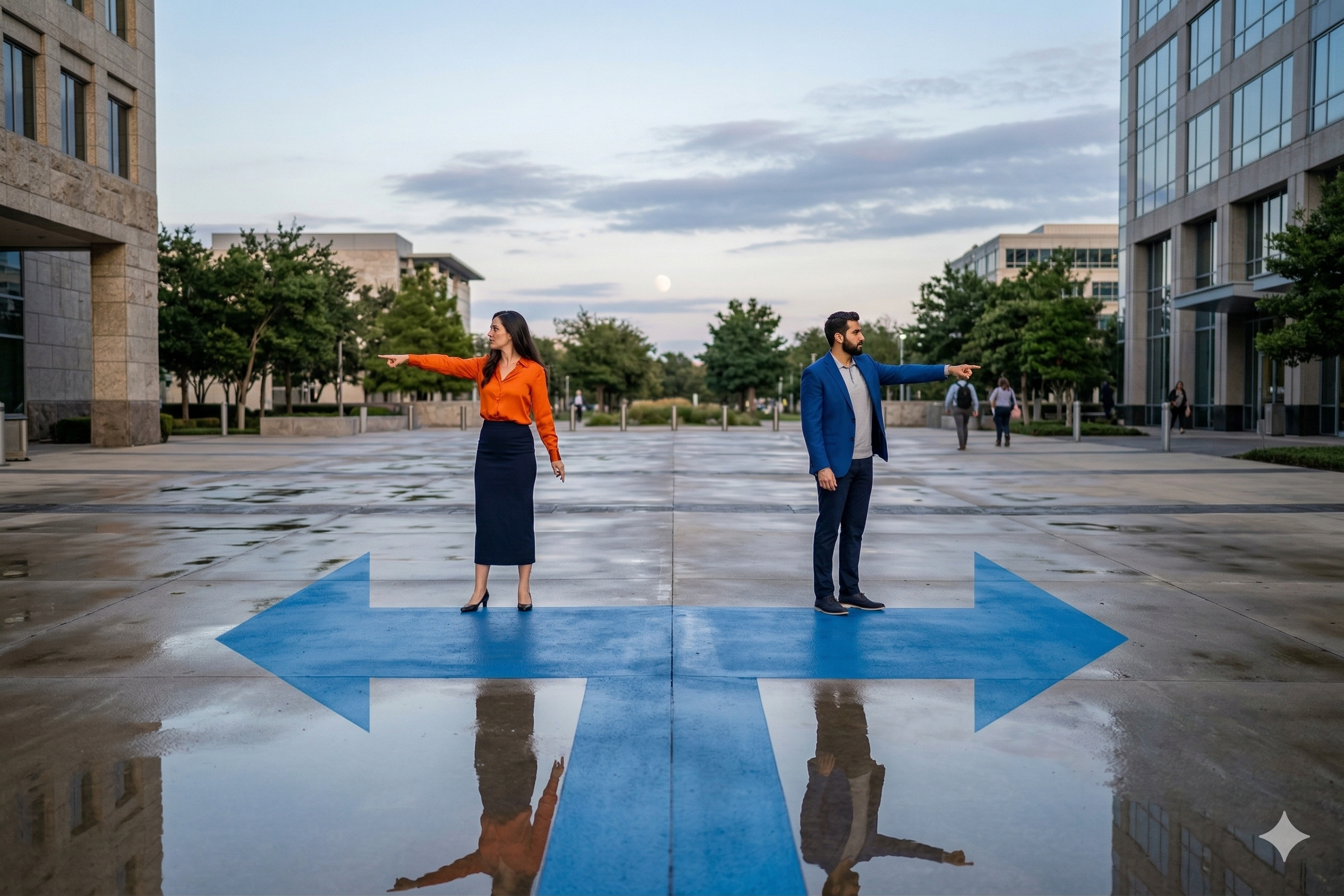
Two people can walk into the same exact property and come up with completely different takeaways from it. One person can think the property feels too small, has an outdated interior, and that it’s overpriced. At the same token, the other person may think the layout is great, has tons of potential, and sees it as a solid deal. What’s interesting is that It’s the same house, the same numbers, on the same day, but both people drew completely different conclusions. Two people can walk into the same exact property and come up with completely different takeaways from it. One person can think the property feels too small, has an outdated interior, and that it’s overpriced. At the same token, the other person may think the layout is great, has tons of potential, and sees it as a solid deal. What’s interesting is that It’s the same house, the same numbers, on the same day, but both people drew completely different conclusions.
That alone should tell you something important. People are seeing things in the same way, even when the information is the same and right in front of them.
The brain is not designed to capture reality; it is designed to react quickly and make decisions with a limited amount of time. Instead of the brain processing everything it sees in detail, it filters out most of the information, fills in surroundings, and predicts what matters most at that specific moment in time for survival. What we think we are “seeing” is just a constructed version of reality that our brain created.
If you stick out your thumb in front of you and look directly at your fingernail, that is all your eyes can see in high detail with 20/20 vision, the rest is all blurred out by your brain which takes a guess on your surroundings. At first this may sound like a flaw, but it is very necessary. If the brain tried to process every detail in full accuracy, it would be too slow to function. In fact, the brain would have to be 600 times larger than it currently is just to process all that information. So instead, the brain sacrifices precision for speed and that tradeoff shows up everywhere in life, especially with real estate and finance where decisions are often made under emotion and uncertainty.

Even though we like to think pricing is objective, it really is not. For example, in real estate we use comps, cap rates, and financial models, but those numbers come from past decisions that were influenced by perception and bias. A comparable is not just a number, but it is the result of what somebody else believed a property was worth at a specific place and time in the past.
You can see this clearly when deals don’t play out as they should in the market. I’ve seen situations where a property sold at a price that doesn’t fully reflect its potential value, and then an appraisal comes in much higher. One example of this is from a buyer I know who purchased property around $500,000 that was later appraised at $720,000. The buyer knew it was a strong deal but did not expect it to be worth more than $680,000. The seller, the buyer, and the appraiser all had slightly different interpretations of what the property was worth.
That gap exists because value is not just calculated, but rather how it is perceived.
This all ties back to something I learned earlier in the year with analog versus digital systems. Analog is often referred to as reality, infinite, while digital is seen as computers, fixed numbers. In a way, the brain behaves more like a digital system than we think. The brain is not trying to perfectly copy the world, but rather it is simplifying it and we see into something that we can act on quickly.
That simplification is also why memory is not as reliable as we think. We tend to treat memory like it is a recording, but it is more like a reconstruction of the past. Every time you remember something, you are rebuilding it based on pieces of information instead of replaying it exactly as it happened. This is often common in court cases where different witnesses recall different events on what played out.
It’s interesting how comparable the human brain is to artificial intelligence. When a large language model doesn’t have all the complete information, it can still produce an answer based on patterns and is probably often referred to as hallucinations. When you think about it, humans do something very similar. We fill in gaps; we make assumptions and create the most reasonable version of reality based on what we have seen and what we know.
Where humans still clearly have an edge is in understanding each other. In real estate especially, a huge part if the decision-making process has nothing to do with numbers. It’s about being able to read situations and act strategically. Why is someone selling? How motivated are they to sell/buy? How is a buyer going to react to pricing, negotiation or timing? A lot of these questions AI cannot yet answer and require a lot of emotional skills and experience.
Could that change? Potentially. If AI reaches a point where it can interpret human emotion and context at a high enough level, then it may be able to directly take over decision-making roles, but for now, that gap is very huge.
Success isn’t just about having more data, it’s about being able to interpret it while understanding the human elements behind it, and as of right now, that’s still something humans do better than machines.
Tool used: ChatGPT (GPT-5.2) Purpose: Structural feedback, grammar suggestions at the end, and title suggestion. All writing and ideas are my own.