If you’ve ever been streaming music in your car and suddenly lost service, you may have noticed something interesting about how cellular service works. Instead of hearing static, like older radios and TVs used to make, the music will only either continue playing smoothly or stop playing entirely. That difference between static vs silence reveals something important about how digital systems work compared to analog.
When we speak into a microphone or listen to music, what we are experiencing are pressure waves traveling through the air. A microphone can convert those waves into an electrical signal that both rises and falls infinitely over time. This type of signal is known as analog since its able to mirror the original sound wave.
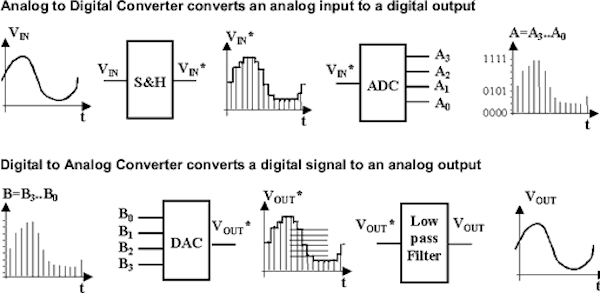
Computers can’t imitate signals that change infinitely like that though. Instead, the signal must be translated into numbers, 1s and 0s to be specific. This is where a device called the Analog to Digital Converter (ADC) becomes critical. The ADC can measure the electrical signal at specific intervals and then assigns a numerical value to each measurement. Over time (the x-axis), these measurements form a digital reflection of the sound.
The accuracy of how this sound is translated depends on how frequently the signal is sampled, and how detailed each measurement is. If the system can measure the signal more often, then it collects more data points and produces a more accurate digital version of the original sound wave. On the other hand, if the system measures signal less frequently, then some of the detail in the original signal is lost. This creates an important tradeoff between quality and quantity. Higher quality audio requires more measurements, which means more numbers must be transmitted and stored.
The real advantage of digital systems is noticed when it comes to noise. When electrical signals travel through wires, they meet resistance, which produces heat. In analog systems, this resistance becomes part of the signal as noise. As the signals travel further and further, the noise increases, and the message becomes distorted.
Digital systems approach this problem differently by interpreting the signal rather than copying it exactly like analog does. Instead of trying to preserve the exact value, the system decides whether the signal represents a 1 or a 0. For example, imagine if 6 electrons represent a 1, while 0 electrons represent 0. If noise causes a few extra electrons to appear during the transmission, the system can still recognize which value was originally intended to be, since 1s and 0s look drastically different.
This is where digital amplifiers play an important role. When the signal reaches a digital amplifier, it does not simply boost the distorted signal the way an analog amplifier would. Instead, it interprets the incoming signal as a binary value, and then sends a brand-new sequence of 1s and 0s. In other words, the amplifier helps rebuild the message rather than amplifying the noise electrons that traveled through the wire.
For example, if a signal was supposed to represent a 0 but the noise added 1 or 2 stray electrons during the transmission, the system can still recognize the intended value was a 0 and regenerate the message as a clean signal again. Because of the huge difference between 1s and 0s, digital systems can much more clearly separate signal from the noise than analog devices ever could.
The ability to rebuild information is one of the main reasons that modern communication systems work the way they do today. Without these digital systems, signals would be very difficult to understand, especially at long distances.
There are still tradeoffs involved though. To recreate sound digitally, the system has to receive enough measurements to rebuild the signal correctly. If a streaming service needs a certain number of data points to play 1 second of music, but hose numbers never arrive, then the system cannot reconstruct the sound properly. This is where the music pauses or stops entirely like I described earlier.
When you step back and look at the bigger picture, being “digital” is not really about computers or smartphones themselves. It is about how information is being translated and represented. Instead of trying to perfectly copy the real world, digital can rebuild and store this information in a very near accurate way, to the point where its hard to see or hear the difference.
Understanding this idea is what makes it obvious as to why digital communication has been the preferred method of communication. Its not only just far faster than older systems, but it is more reliable. By focusing on preserving the meaning of the sound, instead of exactly trying to replicate it, digital systems have made it possible for information to travel across long distances and arrive clearly and accurate on the other end.
Tool used: ChatGPT (GPT-5.2) Purpose: Structural feedback, grammar suggestions at the end, and title suggestion. All writing and ideas are my own.