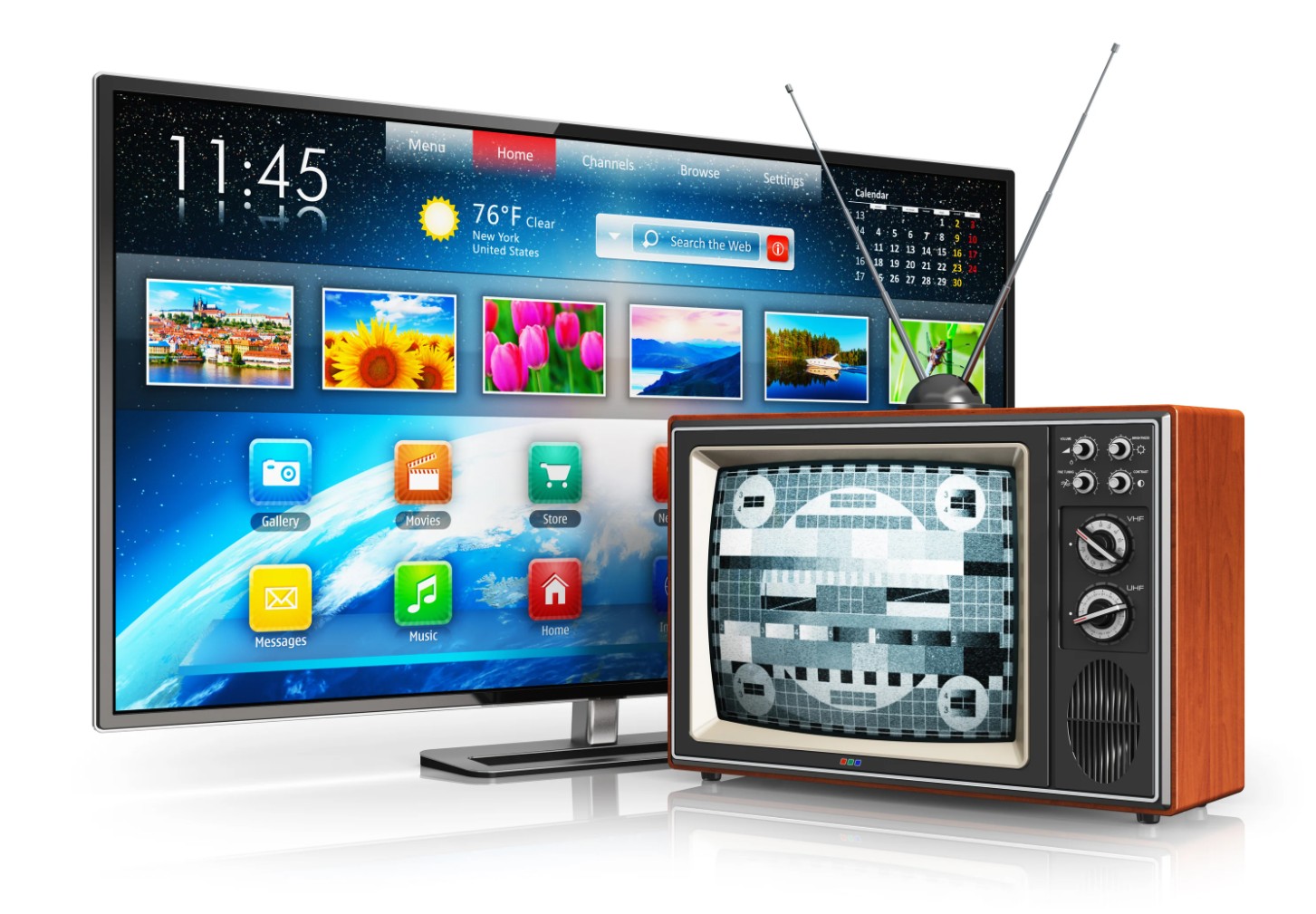
If you have ever watched an old box TV, especially at a grandparent’s house, you may have noticed some static. If you went up really close to the TV, you may have even been shocked by it. All of that is from an analog signal. Now if you have ever watched Netflix freeze and suddenly cut out, you have seen what a digital signal looks like. Both carry information, but in very different ways.
Did you know that analog systems are continuous and infinite, while digital systems are based on fixed values? Analog signals exist naturally in the world and come in all different forms such as color, traditional film, and vinyl records. They are all infinite because two colors could be mixed infinitely with other blends, even though the human eye can only see a fixed number of colors. Digital systems on the other hand convert those signals into numbers, specifically only 1s and 0s. In the case of photographs, they are created into binary pixels which are limited by a fixed number of RGB colors.
Old box televisions were analog, which meant they picked up everything, including noise, which we call static. Large satellite dishes would collect the signal; however, they would also pick up interference, which caused the static. When television switched over to digital, companies began creating converter boxes for older analog TVs so that they would filter out the noise and deliver a clean image. Although the converter helped make the screen clearer, it also meant you would have black bars typically on the top and better since the TV aspect ratios were different. Although the difference between the two was night and day, there was still a gain and a loss.
Tradeoffs also exist in phone calls. Early cell phones used to be extremely large and heavy, often referred to as bricks. The first phone released in 1973 and weighed 2.5 pounds costing nearly $4,000. Only the wealthy people had these phones, and they could only make calls within a certain radius due to the analog signals. Today, phones are entirely digital after 2G and encryption was released on phones to prevent others from interfering and listening into your calls. Digital phones today only transmit a limited range of frequencies (hertz) that match the human speech. This can save the bandwidth, but it also removes anything outside of that range, which is why music sounds strange over a call.
Art is another great example that has a clear difference between analog and digital. A painting such as Rembrandt’s The Night Watch changed over time as pigments in the painting faded. It is claimed that the original painting was a day-time scene, but as centuries passed by the colors became very dark, now appearing to be during the night. The corruption in these colors could be considered the noise and static that I explained earlier about the analog television.
Pigment fading in The Night Watch by Rembrandt acting as a form of “noise,” similar in static is analog televisions (bbc.com, 2019).
Although a painting may look cleaner, digital art stayed the same forever since it is fixed to certain colors. Digital is not immune to noise, however. In the case of digital art, different screen panels can transmit slightly different shades of colors, and as technology advances, digital art could be lost as no one would understand how to use it. Think of old technology and gaming systems, four centuries from now, most of them will be almost gone, broken, and people may no longer know how to use them.
Let’s get your brain to think a little. As technology continues to advance, especially with artificial intelligence, do you believe it currently can disguise itself among people? The Turing Test involves an interrogator and two other individuals, the interrogator will ask several questions before choosing who they believe the copy/impostor is. In this case, we will use a human being and artificial intelligence in a text-based scenario.
I would argue that today, AI could match, if not perform even stronger than humans can today be due to the trillions of datapoints it has already been fed by billions of people daily. We already see this with people communicating with artificial intelligence daily in a conversation like manner. Some people may argue however that AI still struggles with emotional depth, lived experiences, and the physical reality.
Overall, the shift from digital to analog has left us with gains and losses. Today with modern technology, we have gained speed, online storage, efficiency, reliability, encryption, and easier accessibility for those who know how to use it. Some have argued that the digital revolution was as strong if not stronger for productivity than the industrial revolution, and more recently, we have had artificial intelligence see levels of growth unlike ever before. We have had losses due to the digitalized world however, such as texture, physical presence, subtle details, and natural variations. Although digital systems are essential in today’s modern society, they should not be viewed as perfect replacements for our analog reality. They are tools that help make the world more efficient, they are not meant to recreate it, especially when it comes to human connection.
Imon.net. "The Difference Between Digital and Analog Cable TV Channels", 14 June 2017, https://blog.imon.net/2017/06/14/the-difference-between-digital-and-analog-cable-tv-channels
Guner, Fisun. “Why Rembrandt’s The Night Watch Is Still a Mystery.” BBC Culture, 14 Feb. 2019, https://www.bbc.com/culture/article/20190214-does-rembrandts-the-night-watch-reveal-a-murder-plot
Tool used: ChatGPT (GPT-5.2) Purpose: Structural feedback and grammar suggestions at the end. All writing and ideas are my own.